Annual Meeting

500+ Members are Heading to D.C.! Will You Be Among Them?

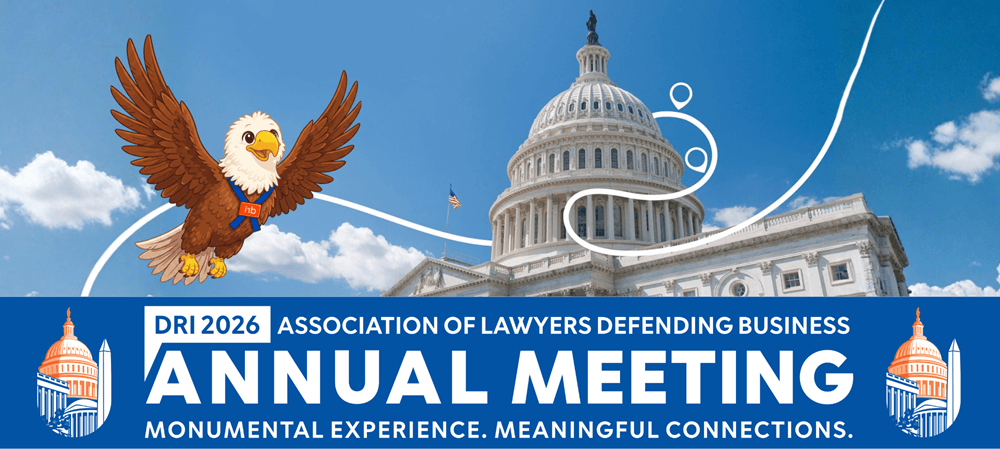
If your trial just wrapped or your calendar suddenly opened up, there's still time to say yes to the upcoming 2026 DRI Annual Meeting in Washington, D.C.

As our nation marks its 250th anniversary, gather with DRI, the Association of Lawyers Defending Business, in Washington, D.C., for a dynamic 2026 Annual Meeting focused on connections, timely insights, and the advancement of the profession.

  • Keynote Speaker: Senator Joe Manchin | Join Senator Joe Manchin and DRI President Elect Jill Rice for a candid fireside chat on leadership, civility, and the enduring role of the rule of law in an increasingly divided environment.
  • Monumental Experience. Meaningful Connections. | The DRI Annual Meeting unites leading civil defense attorneys, in-house counsel, claims professionals, and industry leaders to address the issues shaping our profession.
  • Networking Reception at the International Spy Museum | Included with registration, attendees are invited to an exclusive Networking Reception on Thursday from 6:00 p.m. to 8:00 p.m. inside one of D.C.’s most unique and interactive attractions.

Whether you’re looking to sharpen your skills, reconnect with peers, or simply enjoy the nation’s capital with the best in civil defense litigation, this is your chance to step into the room where it all happens.

Plus, register now to save up to $500!


Center for Law and Public Policy

Updates from the DRI Center

Learn more about the Center or sign up to receive quarterly updates and news.

New Leadership for Center’s AI Task Force

Jin Yoshikawa headshotBrett A. Mason headshot

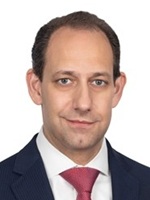
Jin Yoshikawa, Chris Jacobs, Brett Mason

DRI is pleased to announce Jin Yoshikawa as the new chair of the DRI Center for Law and Public Policy’s Artificial Intelligence Task Force. Jin is a member of Butler Snow’s Drug and Medical Device Litigation Practice Group. Practicing from the firm’s Nashville office, he handles a diverse range of matters including nationwide multidistrict product liability litigation, healthcare liability actions, and pro bono matters. Jin uses his background in computer science, artificial intelligence, and machine learning, to work with clients, practitioners, and academics to advance the development of technology law.

Joining Jin in task force leadership is new vice chair Chris Jacobs, a director with Houston Harbaugh in Pittsburgh, where he focuses his practice in the areas of business litigation, insurance bad faith, and insurance coverage. Chris has developed a focus on emerging issues at the intersection of artificial intelligence and the law and advises clients on matters involving AI, including liability frameworks for AI systems and legal implications arising from algorithmic decision-making. His work in this area includes speaking and writing on AI-related legal developments.

DRI and the Center also extends heartfelt gratitude to Brett Mason of Troutman Pepper Locke for her two years of service as AI Task Force chair. Under Brett's leadership, the task force membership grew significantly and oversaw the production of several successful webinars and in-person programs.

The DRI Center for Law and Public Policy and its Artificial Intelligence Task Force are committed to tracking the landscape of AI use in the legal industry, and to continuing to develop best practices and responses to assist all who seek to improve their use of technology like AI in their practices.


DRI Foundation

Beyond the Conference Room: Service, Community, and Well-Being at the 2026 DRI Annual Meeting

By Catherine C. Dugan

The DRI Foundation is ready to help our 2026 DRI Annual Meeting attendees to find service, community, and well-being beyond the meeting rooms in D.C.! Through our fundraising, outreach, volunteer, and wellness initiatives, the Foundation continues its mission of service and support—giving DRI members meaningful ways to contribute to the communities in which they gather while strengthening connections within the profession.

Two Foundation initiatives are central to these efforts: DRI Cares and DRI for Life. Although these programs address different aspects of service and wellness, both reflect a common principle: a strong legal community depends not only on professional excellence, but also on a commitment to the people and communities around us.

DRI Cares provides DRI members with opportunities to give their time, resources, and talents to organizations addressing important needs in local communities. At the 2026 Annual Meeting, that commitment will extend to two organizations in the Washington, D.C. area. DRI Cares is proud to support Friendship Place, a leading housing service provider for people experiencing homelessness in the D.C. region. Friendship Place takes a customized, person-focused approach to helping individuals rebuild their lives, find permanent housing, obtain employment, and reconnect with family, friends, and their communities. Its programs include Veterans First, which provides specialized services to veterans experiencing homelessness. On Thursday, October 22, at noon in the Exhibit Hall, Annual Meeting attendees can support Friendship Place through a hands-on service project assembling care kits for veterans and others in the D.C. community experiencing homelessness.

DRI Cares and the Workers' Compensation Committee will also provide an opportunity for members to support Kids’ Chance of Virginia through a special fundraising happy hour. The event will take place on Thursday, October 22, from 4:30 to 6:00 p.m. at City Tap House, 901 9th Street NW, Washington, D.C., very close to the hotel. We encourage all 2026 Annual Meeting attendees to stop by for a drink, a bite to eat, or both while supporting an important cause. Ten percent of all sales during the event will go directly to Kids’ Chance of Virginia, which provides post-secondary and trade-school scholarships to children of Virginia workers who have been severely or fatally injured in workplace accidents.

For DRI members, these events provide an opportunity to turn the spirit of service into action, while working and networking alongside colleagues. It also reflects the broader purpose of DRI Cares: connecting members with organizations doing meaningful work and providing practical ways for the DRI community to give back!

But service to others is only one component of a healthy and sustainable professional life! DRI for Life recognizes the equally important need for attorneys to invest in their own health, resilience, and personal connections. The initiative provides a forum for conversations about wellness and work-life balance while creating opportunities for members to share experiences, develop support networks, and connect with colleagues outside the traditional professional setting. At the Annual Meeting, DRI for Life will put those principles into practice through two informal opportunities to connect and move!

DRI for Life events will begin Thursday, October 22, with the "Star Spangled Banger" Run/Walk, from 7:00 to 8:00 a.m. Attendees are invited to don their best red, white, and blue and participate in a 5K-ish run or walk through Washington, D.C.! The route will provide an opportunity to experience some of the city's most recognizable buildings and monuments while connecting with both longtime colleagues and new members of the DRI community.

Then, on Friday, October 23, beginning at 7:00 a.m., DRI for Life will offer another opportunity for members to connect during the "Caffeine Convoy." Participants will walk together to Blue Bottle Coffee, located just a few blocks from the hotel, for a morning beverage and conversation with fellow DRI members. Like the Run/Walk, the Caffeine Convoy is intentionally informal. We want to create space for conversation and connection that can be difficult to find during a busy Annual Meeting schedule!

The Foundation's Annual Meeting activities demonstrate that professional organizations can serve purposes that extend well beyond continuing legal education and business development. They can provide opportunities to address community needs, cultivate relationships, and encourage members to consider their own well-being. Whether assembling a care kit for a member of the D.C. community experiencing homelessness, supporting scholarships for children affected by workplace tragedies, taking a morning walk past the nation's monuments, or simply sharing coffee with a colleague, we at The DRI Foundation hope that these activities provide reminders that some of the most meaningful aspects of professional life happen beyond the conference room! See you in D.C.!

DRI Foundation President Catherine C. Dugan of Peterson White LLP is a litigation attorney who has practiced in the insurance defense industry since 2004. She has handled claims from workers’ compensation to general liability to coverage and has worked in private practice and in-house. For most of her career, Cate’s focus has been on defending employers and insurance carriers in workers’ compensation claims, assisting her clients as they navigate necessary administrative procedures, and defending claims through litigation, as necessary.


Free Webinar Series

Where AI Delivers the Most Value in Legal Practice

DRI Free Webinar Series for attorneys law firms

Don't miss out on the upcoming free webinar next month: Four Ways Lawyers are Using AI: Insights from DRI’s AI Skills Lab

This upcoming webinar (November 12, 2026 | 11:00 a.m.–12:00 p.m. Central) brings together practical insights from DRI’s 2026 AI Skills Lab to examine how lawyers are putting AI to work across different areas of practice.

Our presenters, Henry M. Sneath and Christopher M. Jacobs, will explore four applications of AI including legal research and matter analysis, deposition preparation and defense, marketing and client development, and data-driven case analysis.

Through real-world examples, attendees will learn where AI adds value, where caution is needed, and how to effectively incorporate these tools into their practice.

Register and reserve your spot today!

Click here to learn about our Free Webinar Series.


Member Stories

More Than a Place to Practice: Building a Legal Career in Appalachia

By Jonah Samples

Ask most lawyers to picture legal practice in Appalachia, and the image tends to be a small-county courthouse, a light docket, and little of the complexity that defines a major market. Appalachia is a far more varied region than the stereotype suggests, and the legal work it generates can be every bit as demanding as the work found in any sophisticated market. Practicing here well calls for two things at once: the technical rigor expected anywhere and a real understanding of the local institutions, courts, industries, and relationships that shape how matters actually get resolved. It is also, in my experience, a genuinely rewarding place to build a career.

A Bigger Place Than You Might Think

The Appalachian Region, as defined by the Appalachian Regional Commission, stretches from southern New York to northern Mississippi along the Appalachian Mountains. It encompasses 423 counties across 13 states and is home to approximately 26 million people. It includes deeply rural communities, mid-size cities, and metropolitan areas, with West Virginia as the only state located entirely within the region. Appalachia also defies easy economic categorization. The region includes university medical centers and advanced manufacturing operations, agricultural valleys and energy corridors, financial institutions and technology companies, tourist destinations and industrial communities. In many places, traditional industries now exist alongside substantial new investment and economic development.

That variety produces interesting legal work, and a career spent practicing here has convinced me that Appalachia is an underappreciated place to practice law. The work is sophisticated, the professional community is close-knit, and the region is changing. Lawyers practicing here have the opportunity to work on matters that reach well beyond the region while developing the kind of knowledge and relationships that come only from spending time in a place. There is something particularly rewarding about doing consequential work in a community and region you actually know.

Sophisticated Work Does Not Require a Big City

One of the persistent misconceptions about rural and regional practice is that the work must somehow be less sophisticated than the work performed in a major legal market. My experience has been the opposite. Appalachian practice can involve complex commercial litigation, banking and financial services, real estate and development, energy, healthcare, manufacturing, arbitration, and disputes involving parties and lawyers from across the country. The industries operating here face complicated legal problems just as they do anywhere else, and a matter pending in a relatively small Appalachian community may involve a national company, significant financial stakes, and lawyers located hundreds of miles away.

What can be different is the breadth of experience available to the lawyer handling those problems. In markets that are not divided into narrow professional silos, lawyers often develop versatility. Younger lawyers may receive direct client contact, take depositions, argue motions, appear in court, and manage meaningful portions of matters relatively early in their careers. With appropriate support and supervision, that responsibility develops something difficult to learn from a book or CLE program: judgment. You begin to understand not simply how to complete an assignment, but how the pieces of a matter fit together, what matters to the client, and what the client should do next. That kind of responsibility can also allow a lawyer to develop a professional identity relatively early in a career.

A National Platform and a Regional Practice

The evolution of national and multi-office law firms has made regional practice even more interesting. A lawyer no longer necessarily has to choose between practicing in a smaller community and having access to the resources associated with a national platform. From an Appalachian office, lawyers can work with colleagues across the country, draw upon specialists in different industries and areas of law, and represent clients whose operations extend far beyond the region. Technology has made collaboration across offices ordinary, but it has not eliminated the value of having lawyers who are actually present in the markets where clients operate and disputes arise.

The benefit runs in both directions. A lawyer practicing regularly in a region develops knowledge that is difficult to replicate from afar, including familiarity with courts and institutions as well as an understanding of the industries, geography, professional community, and economic circumstances surrounding a matter. The national platform provides reach and specialized resources, while the regional practice provides context. The combination allows a lawyer to build a practice extending well beyond the place where the lawyer happens to sit without giving up the advantages that come from being deeply connected to that place.

The Value of Knowing the Place

That connection becomes particularly important when litigation brings a company or its primary counsel into an unfamiliar jurisdiction. Good local counsel should offer much more than assistance with admission to a particular court or knowledge of the local rules. The written rules matter, of course, but understanding a jurisdiction involves more than reading them. Every court has its own practices and expectations, and every community has economic and institutional context that may matter to a dispute. A lawyer who regularly practices in a place can help a litigation team understand which local considerations are important and, just as importantly, which ones are not.

The best litigation teams I have worked with recognize this and treat lawyers on the ground as members of the strategic team rather than as a procedural requirement. Likewise, good local counsel learn the case, understand the client's objectives, identify issues that may not be apparent from a distance, and contribute substantively to the representation. There is no mysticism to local knowledge. It is context, and context helps lawyers exercise better judgment. That principle is hardly unique to Appalachia. It matters whenever lawyers are asked to advocate effectively in a place they do not regularly practice. Appalachia simply provides a particularly good illustration of it because a dispute involving a national company and lawyers from several states may still find its way to a courthouse in a relatively small community. The issues can be national in scope while knowledge of the place remains valuable.

Reputation Travels Quickly

Smaller legal communities also teach an important professional lesson about reputation. You are likely to encounter the same lawyers again, and today’s opposing counsel may later become co-counsel, a referral source, or a colleague in a bar or community organization. Judges see many of the same practitioners over time, and clients and business leaders operate within overlapping professional networks. Preparation, candor, civility, and follow-through therefore become part of the reputation a lawyer carries from one matter to the next. There is a healthy accountability in knowing that a scorched-earth approach to today's dispute does not erase itself when the case ends.

For me, the relationships that grow from that environment have been among the most rewarding aspects of Appalachian practice. The bar can be competitive without becoming anonymous, and professional familiarity does not require sacrificing vigorous advocacy. If anything, repeated interaction creates an incentive to be both a strong advocate and the kind of lawyer others are willing to work with again. Over time, those relationships make the practice feel less like a collection of unrelated matters and more like participation in a professional community.

The Law Feels Connected to Something

There are also rewards that are harder to capture in a description of a practice area. There is something satisfying about spending the morning working through a difficult commercial issue, talking that afternoon with colleagues or clients several states away, and then driving home through the mountains. The surrounding landscape is part of ordinary life rather than something reserved for vacation. A demanding practice remains demanding, of course, but it can exist alongside a connection to the outdoors, to a community, and to a place that is difficult to separate from the work itself.

The work also tends to feel tangible. You may drive past the property involved in a dispute, watch a development move from documents on your desk to construction along a road you regularly travel, or understand why a particular employer or investment matters because you know the community where it is located. None of that changes a lawyer’s professional obligations, but it does provide perspective. Cases and transactions do not exist only in pleadings, contracts, conference rooms, and courtrooms. They involve businesses, employees, investments, and communities. Practicing close to those things is a regular reminder that legal advice has consequences beyond the four corners of a document, and that perspective can make us better counselors.

A Place With Room to Build

There is another reason lawyers should take rural practice seriously: many of these communities need them. A 2026 report from the West Virginia Commission on the Future of the Practice of Law noted that 46 of West Virginia's 55 counties qualify as "legal deserts," using the American Bar Association's measure of fewer than one lawyer for every 1,000 residents. The Commission also reported a decline in the number of active, in-state attorneys over the preceding decade and substantial expected retirements among private practitioners. Those numbers present serious access-to-justice concerns, but they also illustrate the extent to which there are communities where capable lawyers can become genuinely useful.

That does not mean every lawyer should leave a city for a small town, nor does it mean rural practice is right for everyone. It does mean that geography should not be treated as a proxy for professional opportunity. A place with fewer lawyers may offer greater responsibility, stronger professional relationships, and room to develop a practice that matters to the community around it. For young lawyers in particular, the question should not simply be where the largest legal market is. Better questions might be where they will receive responsibility, where they can develop lasting relationships, where their knowledge can become valuable, and where they can build both a practice and a life.

There Is Good Work Here

Appalachia is only one example. Lawyers practicing in smaller communities throughout the country can tell similar stories about sophisticated matters, early responsibility, close client relationships, and the professional value of knowing a place well. For lawyers who practice primarily in major metropolitan markets, regions like Appalachia are worth understanding. Companies invest here, businesses operate here, and disputes arise here. As the region's economy continues to evolve, its legal needs will evolve with it, and lawyers who understand both the legal issues and the places where those issues arise will continue to have an important role.

I have found in Appalachia the things I hoped to find in a legal career: challenging work, meaningful responsibility, good lawyers to work with and against, and a sense that the work is connected to something beyond itself. The reward of practicing here is not discovering that an interesting legal career is possible despite being in Appalachia. It is discovering how much more interesting a legal career can be because you are here.

Jonah Samples is a senior associate and commercial litigator in the West Virginia office of Nelson Mullins, where he represents companies in business disputes across the Appalachian region. He has litigated cases from pleadings through appeal in both trial and appellate courts, with a focus on clients in the energy, financial services, and real estate industries. Jonah's courtroom work draws on his parallel practice as an economic development lawyer, in which he counsels businesses and organizations on the legal issues that shape investment and growth in Appalachia. That background gives him a practical command of the region's industries, institutions, and business relationships, which is often what decides a commercial dispute. He applies that knowledge at every stage of a case, from assessing early risk to framing arguments for trial and appellate courts.


DRI Cares

Support Friendship Place at DRI’s Annual Meeting

DRI Foundation, DRI Cares logoDRI Cares is proud to support Friendship Place at this year’s Annual Meeting. Friendship Place is the premier housing service provider for people experiencing homelessness in the D.C. region. Their innovative, customized, person-focused programs, including Veterans First, empower participants to rebuild their lives, find homes, get jobs, and reconnect with friends, family, and the community, permanently!

Please join us on Thursday, October 22 at 12:00 p.m. in the Exhibit Hall to make care kits for veterans and others in the DC community who are experiencing homelessness.

DRI Cares is dedicated to giving members the opportunity to support amazing organizations through fundraising and volunteer activities. Help a great cause and connect with your peers through DRI Cares events.


DRI Member News

Congratulations to DRI Members for Their Achievements

If you have a recent achievement or recognition that you would like featured, email your news to membership@dri.org. Please note that DRI reserves the right to review all accomplishments to ensure they are adequate for publishing. All submissions will be reviewed for relevance and compliance with DRI’s mission. Submissions may be edited to conform with our standards, and space limitations.

Winston & Strawn and Taylor Wessing’s U.K. led business have merged as Winston Taylor, a transatlantic law firm with more than 1,400 lawyers.

Peter Bredin, of Dillon Eustace, has been appointed as Head of Commercial Litigation. Bredin has been a member of DRI since 2016.

Edward Tugade, of Demler Armstrong & Rowland, LLP, has been elevated to Equity Partner at their San Francisco, CA office. Tugade has been a member of DRI since 2021.

Rodney Dillard II, of Baker Donelson, has been elected as shareholder. Dillard has been a member of DRI since 2022.

Justin Meyer has joined Buchalter as an associate at their Portland, OR office. Meyer has been a member of DRI since 2024.

Kasey Farmer has joined Teague Campbell Dennis & Gorham LLP as an attorney at their Asheville, NC office. Farmer has been a member of DRI since 2024.

Tyler Hermsen has joined Frey Buck as an attorney at their Seattle, WA office. Hermsen has been a member of DRI since 2024.

Jason Whitehead has joined Amundsen David, LLP as an associate at their Columbus, OH office. Whitehead has been a member of DRI since 2025.

Lesvia Alvarado has joined Ensign Services, Inc at their San Juan Capistrano, CA office. Alvarado has been a member of DRI since 2026.


DRI Foundation

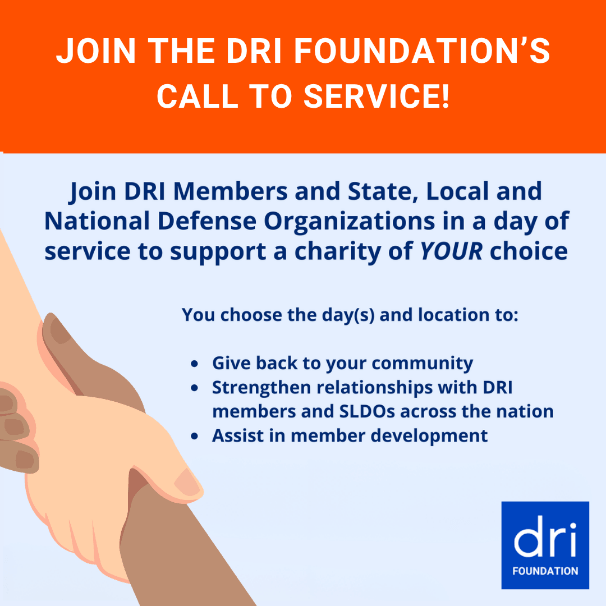
Participate in the DRI Foundation's Call to Service!

The DRI Foundation invites all State, Local, and National Defense Organizations (SLDOs/NDOs) to support the 2026 Call to Service. Previously known as the International Day of Service, the DRI Foundation encourages SLDOs and NDOs to hold service projects at any time during the year. They do not need to take place on a particular day or month.

The goal of the Foundation is to better support and bring awareness to the wellness, philanthropic and charitable efforts of defense lawyers across the country. The Call to Service is one of the steps the DRI Foundation is taking to expand, better coordinate, and streamline the holistic betterment of the civil defense bar.

We welcome all SLDOs/NDOs to be a part of the 2026 Call to Service. Please complete the form below and let us know about your planned or completed projects so we can track participation, share best practices, and recognize your good work.

Fill out the form below. Don't see the form? Click here.


SLDO News

Leadership Updates

Several State, Local, and National Defense Organizations hosted their Annual Meetings in recent weeks. DRI members assumed new officer roles at the conclusion of the following business meetings.

  • Iowa Defense Counsel Association
    Jon Vasey: Iowa President: DRI Member since 4/1/1983
    Joshua Strief: Iowa President Elect: DRI Member since 8/1/2018

New Members and Advocates

DRI Welcomes the Following Members and Advocates

New Members

  • Sylvia Soliman Aceves
  • Jennifer E. Adams
  • Lesvia Alvarado
  • Christopher Amrhein, Jr.
  • Kathryn M. Anbinder Covarrubias
  • Daniel Patrick Avery
  • Neil Baine
  • Katherine Bandy
  • Bob Baronian
  • Charles Barreras
  • Mark A. Bartholomaei
  • Stacey Lynne Beaumont
  • Stephen Berry
  • Jay Bissin
  • Bridget A. Blinn-Spears
  • Chris M. Borunda
  • Robert Brawner
  • Kelly McCall Brian
  • Sarah Britt
  • Chad P. Brouillard
  • Trevor J. Brown
  • Carole J. Buckner
  • Colin Buckner
  • Brian M. Bursa
  • James Burton
  • Benjamin Byrd
  • Jayme Cannady
  • Amy Carlson
  • Michael Cedillo
  • Jessica Chapman
  • Jonathan O. Chenoweth
  • Kammann Cole
  • Robert M. Cook
  • Jason R. Corrado, Sr.
  • Robert J. Cosgrove
  • Lisa A. Costello
  • Rabin K. Das
  • Melvin J. Davis
  • Mark DelRosario
  • Imani Dixon
  • Kimberly Kay Dodd Anderson
  • Justin Elkin
  • Paul A. Elkort
  • Jeffrey Erdman
  • Peter Estall
  • Richard Fama
  • Jeffrey B. Fecht
  • Campbell Bowman Fetzer
  • Ashley Heather Fine
  • Aneta Freeman
  • Jessica Rachel Garrity
  • George Gibbs
  • Veronica R. Gobran
  • Jonathan Gonzalez
  • Brett Goodman
  • Katherine Graf
  • Jared Paul Green
  • Veronica H. Gromada
  • Cole Guyton
  • Molly Sue Harmon
  • Liz Harris
  • Todd R. Harris
  • S. Ault Hootsell, III
  • Michelle Hou
  • John M. Huff
  • Jasmyn Jackson
  • Glenn A. Jacobson
  • Shannon Kain
  • Pamela R. Kaplan
  • Brandon Kessinger
  • Allison Knerr
  • Jennifer L. Knobloch
  • Yugo Komori
  • Patrick Kukla
  • Joshua Kundert
  • Phillip Jeremy Lafleur
  • Kathryn Lapin
  • Stephen M. Larzelere
  • Michelle LeGault
  • David L. Lindsey
  • Joe Little
  • Michael Lopez
  • Gregg J. Lytle
  • William Mattingly
  • Terrence P. McAvoy
  • Mark D. McCurdy
  • Gregory McGroarty
  • Justin McManus
  • Aidan C. McNally
  • Rakhi Dalal McNeill
  • Byron N. Miller
  • James Mills
  • Ian Ray Mitchell
  • Matthew D. Moghis
  • Matthew S. Morrison
  • Bree'ara Murphy
  • Kimberly Nelson
  • Lane Newbold
  • Benjamin Edward Nicholson
  • Harry D. Norton, Jr.
  • Lauren Elizabeth Nuffort
  • Michael J. Olds
  • Thomas F. Olsen
  • Lisa Marie Only
  • Anthony Osterlund
  • Olivia Palmer
  • Hillary D. Patton
  • Ruwan C. Perera
  • William Philpot
  • Jon Pisiewski
  • Kaitlyn M. Posta
  • Melissa Pressley
  • April Quinones
  • Juan S. Ramirez
  • Kent D. Riesen
  • Cynthia Robinson
  • Marie Rodolfa
  • Aris Rogers
  • Robert J. Romero
  • Elias G. Saboura-Polkovotsy
  • Brian M. Sanders
  • Carmen Santana
  • Jay Sarmaz
  • Matthew Mark Schroeder
  • Elizabeth Sconzert
  • Benjamin Gross Shatz
  • Kimberly Sheridan
  • Hunter Siex
  • Kimberly G. Silvus
  • Matthew Anthony Smartnick
  • Eric J. Stockel
  • Frank Harry Stolba, III
  • B. W. Stone
  • Stacey L. Strain
  • Ashlie Surur
  • Sarah Elyse Swale
  • Travis Swallow
  • Nicholas Tait
  • Debra Chilton Teague
  • Trey Thacker
  • Hope Thomas
  • Orla G. Thompson
  • Tara Toevs-Carolan
  • An-Li Tran
  • Berlin Tsai
  • Christopher Unger
  • Lana K. Varney
  • Ruth Veilleux
  • Julia Vizzaccaro
  • Benjamin Charles Wade
  • Stuart Walker
  • John Walker Webb
  • Steven T. Walsh
  • Matthew Brannan Waters
  • Alissa Netto Watson
  • Paula M. Wellons
  • Dixie T. Wells
  • Austin Westerberg
  • Eleanor P. White
  • W. McElhaney White
  • Jason E. Williams
  • Robert Whitfield Williams, III
  • Lilith Vala Xara
  • James E. Yeager, III
  • Stacy M. Young
  • Chelsea Zwart

Advocates

  • Darrin W. Banks
  • Sarah Sloan Batson
  • Mark S. Boardman
  • Emilee Mae Bramstedt
  • Daniel L. Bray
  • Mario J. Delano
  • Desiree Patrice Dixon
  • Stacy Lynne Douglas
  • Zandra E. Foley
  • W Bradley Gilmer
  • Ryan M. Hathcock
  • Matthew J. Lavisky
  • R. Jeffrey Lowe
  • Michael P. Lowry
  • Robert A. Luskin
  • Michael A. Malia
  • Matthew G. Moffett
  • Shelby Jene Nathans
  • Jonathan Ohlsen
  • Dorie Ortiz
  • Michael S. Reeves
  • Anthony Stastny
  • Jennifer Davis Ward
  • Todd Weston
  • Amy J. Wilkinson

DRI Education

Upcoming Seminars

2026 DRI Annual Meeting
October 21–23, 2026 | Washington, D.C.

As our nation marks its 250th anniversary, gather with DRI, the Association of Lawyers Defending Business, in Washington, D.C., for a dynamic 2026 Annual Meeting focused on connections, timely insights, and the advancement of the profession. Save up to $500 when you register by October 20!

2026 Asbestos Medicine Seminar
November 18–20, 2026 | Nashville, Tennessee

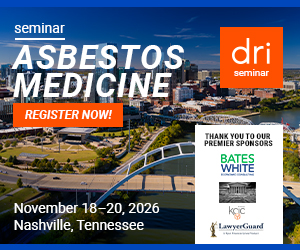
Join us in Nashville for DRI's Asbestos Medicine Seminar, where cutting-edge science, high-stakes litigation strategy, and the future of law converge. This year we are shaking up the traditional conference format with a fully immersive, human and AI-powered mock trial. Following educational primers, we will present a complete asbestos case: opening statements, direct and cross-examinations of key witnesses, and closing arguments. A live jury will hear the case alongside the audience. You will then watch them deliberate via real-time stream, then hear directly from the jurors on what persuaded them and what did not. AI experts from Stanford University and Viewpoints.ai then reveal how an AI jury evaluated the same facts, offering a direct comparison between human and artificial decision-making. All of it in the heart of Nashville, steps from live music and award-winning restaurants. Save up to $500 when you register by November 17!

2026 Insurance Coverage and Practice Symposium
December 2–4, 2026 | New York City, New York

Join leading insurance coverage practitioners, claims professionals, and counsel at the 2026 Insurance Coverage and Practice Symposium, hosted by DRI's Insurance Law Committee in New York City. Over two and a half days, attendees will examine key developments shaping insurance litigation and coverage practice. Sessions will cover insurers' role in promoting safety and stability, strategies for trying bad faith cases, and the challenges posed by AI-powered claimants using generative tools in litigation. Other topics include emerging coverage issues in social media, influencer marketing, digital platforms, rideshare, autonomous vehicles, and mobility trends; how artificial intelligence is reshaping risk transfer, indemnity, and contractual risk allocation; ethical obligations within the tripartite relationship; defenses to collusive judgments and manufactured liability; and recent developments in first-party property coverage. Attendees will leave with practical, actionable insights and expanded professional connections through networking events and committee activities. Save up to $700 when you register by October 19!

2026 Professional Liability Seminar
December 2–4, 2026 | New York City, New York

Get practical strategies for navigating today's toughest professional liability challenges. This seminar brings together attorneys and claims professionals defending licensed professionals across multiple disciplines for timely insights on pro se plaintiffs, profession-specific liability trends, claims handling, mock voir dire, ethics in the digital age, and talent retention. Through interactive sessions, breakout tracks, and hands-on programming, you'll gain actionable takeaways you can put to work immediately while building valuable connections with leading defense counsel and claims professionals from across the country. Save up to $700 when you register by October 19!

2027 Product Liability Conference
January 20–22, 2027 | Atlanta, Georgia

DRI's Product Liability Conference delivers practical skills, emerging AI and litigation trends, and insight from clients on what they want from outside counsel. Our Specialty Litigation Groups open the conference Wednesday with a diverse mix of practical presentations that are valuable across every practice area. Thursday's main stage features dynamic speakers on mediation, crisis management, and using jury consultants effectively throughout a case. We will also look at how plaintiffs are leveraging AI and how defense counsel can respond. Plus, you'll hear directly from in-house counsel on what they value in outside counsel and how to stand out. Finally, Friday brings back our popular Interactive Session, where you'll see clients' products in action and learn how experts assist when those products become the subject of litigation. Save up to $700 when you register by December 7!


Quote of the Month

“October Country . . . that country where it is always turning late in the year. That country where the hills are fog and the rivers are mist.”
― Ray Bradbury